
7 Best Eco-Friendly Car Waxes in 2026 for a Greener Shine
Last Updated: November 8, 2026
Quick Summary
The best eco friendly car wax in 2026 is Surface Shield, a plant-based paint coating with no PFAS or PTFE that bonds to paint and enhances colour. It is ready to drive in minutes, so it fits a normal wash routine rather than a dedicated detailing session. For bikes and rims, Frame Protect applies the same plant-based approach to matte and gloss surfaces.
- Surface Shield costs €15.95 for 500 ml and €63.95 for 5 litres, with free shipping from €49.
- Frame Protect is a 500 ml spray at €13.95 for bike frames, chains and wheels.
- Spray waxes typically last two to four weeks, liquid coatings four to eight weeks, and paste waxes six to twelve weeks.
- Apply wax in the shade on a cool panel, one panel at a time, in thin even layers.
- Wash applicators and towels in a bucket and keep rinse water out of storm drains.
Table of Contents
- What Makes a Car Wax Truly Eco-Friendly in 2026
- How We Chose and Tested These Eco-Friendly Waxes
- 1. Surface Shield: Best Overall Plant-Based Car Wax
- 2. Frame Protect: Best Eco-Friendly Wax for Bikes and Rims
- How to Apply Car Wax for a Streak-Free Finish
- How Long Does Car Wax Last in Dutch Weather?
- Car Wax vs Ceramic Coating: Which Protection Suits You?
- Choosing Your Eco-Friendly Car Wax
- Frequently Asked Questions
What Makes a Car Wax Truly Eco-Friendly in 2026
An eco-friendly car wax is a paint protection product formulated with plant-based or biodegradable ingredients, free from persistent chemicals like PFAS and PTFE, and manufactured without hazard-symbol labelling.
That distinction matters more than most buyers realise. Plenty of products carry a green leaf while relying on the same solvent base as a conventional wax.
Three things separate a genuinely low-impact wax from a marketing claim: ingredient transparency, verified absence of persistent chemicals, and a formula that still protects your paint. A wax that fails on durability forces constant reapplication, more product, more packaging, more runoff. Performance and environmental impact reinforce each other here.
Below, we break down the ingredients to avoid, how we selected our picks, and which format suits your car, your bike and your routine.
Ingredients to Avoid and What to Look For
PFAS and PTFE are the two families to screen for first. PFAS, often called forever chemicals, do not break down in the environment and accumulate over time. PTFE is a fluoropolymer used to add slickness. Neither belongs in a product you spread across a large painted surface and then buff off outdoors.
Look instead for plant-based active ingredients, a clear ingredient list, and packaging that states the absence of hazard symbols, a strong signal the formula is safe to handle without gloves and heavy ventilation.
If you want the full picture on why this matters for bikes as well as cars, our guide to why PFAS-free bike maintenance matters explains how to spot PFAS in cleaners and switch safely.
How We Chose and Tested These Eco-Friendly Waxes
Our top pick, Surface Shield, is a plant-based paint coating that bonds to paint and enhances colour without heavy wax buildup. It is ready to drive in minutes, ideal for protecting a car between washes rather than planning a full detailing session.
We also weighed format. Spray waxes suit quick top-ups, liquids cover large panels evenly, and paste waxes reward patience with a deeper gloss. For most drivers, a spray or liquid coating delivers the best balance of shine retention and time spent.
| Criterion | What We Checked | Why It Matters |
|---|---|---|
| Ingredient transparency | Plant-based actives, no PFAS or PTFE | Verifiable low impact |
| Protection | Water beading, dirt repellency | Fewer reapplications |
| Application | Streak-free finish, buffing effort | Usable by hand |
| End of life | Bottle size, packaging, coverage | Less waste per car |
1. Surface Shield: Best Overall Plant-Based Car Wax
Surface Shield is our top pick for the best eco friendly car wax in 2026. Its plant-based active ingredients bond to the paint and enhance colour.
Ready to drive in minutes, it fits a normal wash routine rather than demanding a dedicated afternoon.
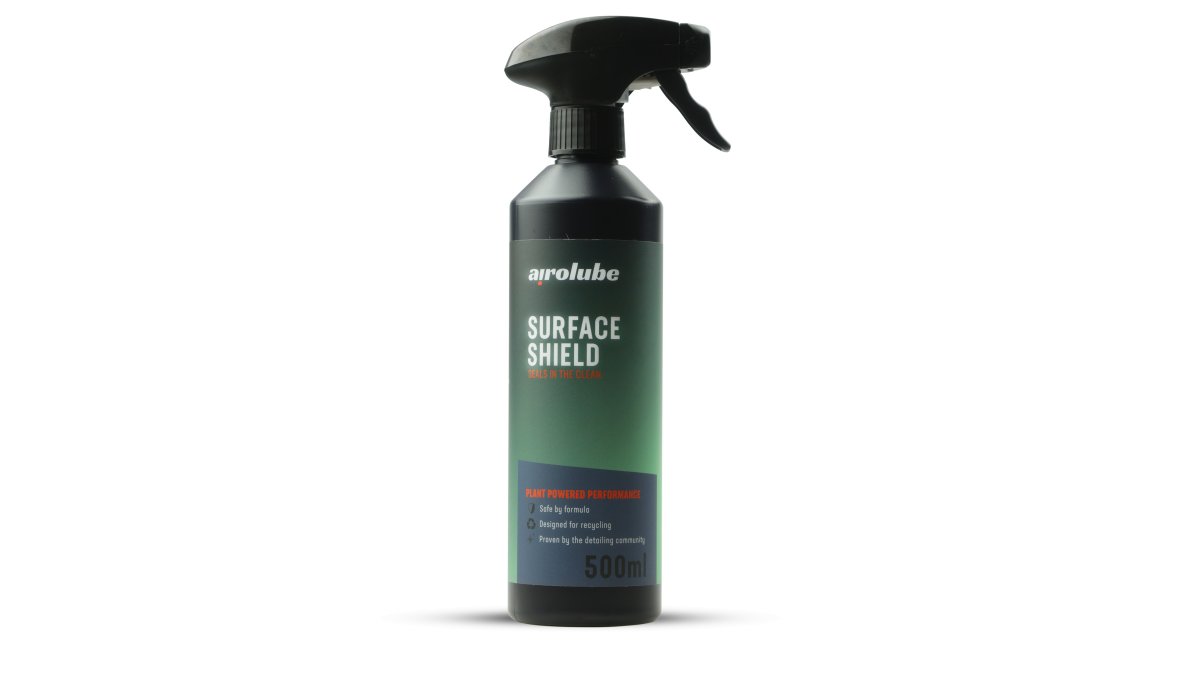
Best for: drivers who want verified plant-based protection and a fast, streak-free finish.

Pricing and Sizes
Surface Shield comes in two bottle sizes. The 500 ml bottle is €15.95, and the 5 litre container is €63.95. Orders from €49 ship free.
You can shop Surface Shield in the size that matches how often you wax.
2. Frame Protect: Best Eco-Friendly Wax for Bikes and Rims
Frame Protect applies the same plant-based approach to two-wheeled surfaces. It is a wax-based protection spray for bike frames and rims that repels dirt and water while conditioning colour and finish, and it suits both matte and gloss surfaces.
Frame Protect is suitable for both matte and gloss surfaces.
It is listed for bike frames, chains and wheels, and it repels dirt and water.
Best for: cyclists and riders who want one spray for frames, rims and matte finishes. Skip if: you only ever clean painted car panels.
Frame Protect is available in a 500 ml bottle at €13.95 and a 5 litre container at €53.95. You can buy Frame Protect directly.

How to Apply Car Wax for a Streak-Free Finish
Application is where most wax disappointments happen, and where the eco-friendly choice has practical consequences. A thin, even layer uses less product per car, fewer bottles bought, less residue washed off. The method below works for spray, liquid and paste formats, with format-specific adjustments noted.
Step 1: Wash, decontaminate and dry
Wash the car panel by panel with a pH-neutral shampoo, then dry fully with a clean microfiber towel. Any dust, tar spot or water mineral left on the paint will be trapped under the wax and show as haze or streaks. On a car unwaxed for months, a clay bar pass before waxing removes bonded contaminants and makes buffing noticeably easier.
Step 2: Work in the shade on a cool panel
Apply wax to a cool surface, out of direct sun. A hot panel makes the carrier flash too quickly, leaving uneven patches that are hard to buff out. Work one panel at a time, bonnet, then front wing, then door, rather than waxing the whole car before buffing.
Step 3: Apply thin, even layers
Dispense product onto a foam or microfiber applicator, not directly onto the paint. Two thin passes cover a panel better than one heavy pass, and a heavy pass is the most common cause of white residue in panel gaps and around badges. For sprays, two light mist passes per panel into a microfiber towel; for liquids, a 10-15 ml line on the applicator covers a door panel; for pastes, a barely visible film is the target.
Step 4: Respect the bond time
Let the product bond for the time stated on the label before buffing. Spray and liquid coatings typically haze in one to three minutes; paste waxes take five to ten depending on temperature and humidity. Buffing too early smears the carrier; too late makes the residue hard and dusty.
Step 5: Buff with two towels
Buff with a clean, dry microfiber towel, flipping it often to a dry face. Finish with a second, separate towel for the final gloss pass. Using one towel for the whole car loads it with residue and spreads haze from panel to panel.
Step 6: Manage runoff and applicator waste
Wash applicators and towels in a bucket, not under a running hose, and dispose of the wash water down the domestic drain rather than a storm drain. Storm drains typically discharge to surface water without treatment, so rinse water carrying wax residue, shampoo or tar remover should not go there. Check the label and local municipal guidance for leftover product; do not pour it into a drain or onto the ground.
Watch out: buffing a panel that is still wet or dusty spreads residue rather than removing it, and that haze can be stubborn to lift.
A proper applicator makes the biggest difference to an even, residue-free result. Our applicator sponge is designed for exactly this step.

How Long Does Car Wax Last in Dutch Weather?
Durability is the eco-friendly wax question that most rankings skip, because a wax that fails early forces more reapplications, more product, more packaging and more runoff per year of protection. The honest answer is that durability depends on format, exposure and prep, and that plant-based formulas trade some longevity for a lower-impact chemistry.
What to expect by format
Spray waxes and spray coatings are shortest-lived, typically two to four weeks on a daily-driven car. Liquid coatings sit in the middle, often four to eight weeks. Paste waxes are the longest-lasting traditional format, commonly six to twelve weeks. Ceramic-enhanced and hybrid formulas extend those windows modestly rather than transformatively. Treat any label claim of months of protection as a best-case figure measured on a garaged, gently driven car.
Why plant-based formulas degrade
Plant-based actives and natural waxes are softer and more polar than synthetic polymer sealants, so they oxidise and wash away faster under UV, repeated washing and road film. That is the trade-off for a formula that biodegrades more readily and avoids persistent fluoropolymers. The practical response is to judge by water behaviour, not the label interval.
Judge by beading, not by the calendar
When water stops forming tight beads and starts sitting flat on the paint, the protection has thinned and it is time to reapply. A car parked outside under trees will lose protection faster than a garaged one because of sap, bird droppings and UV.
The exposure factors that shorten life
- Road salt and winter gritting: salt film breaks down wax films quickly and should be rinsed off promptly.
- Coastal wind and salt spray: fine salt carried on the wind settles on paint and accelerates degradation.
- Repeated washing: every wash removes a fraction of the wax; a pH-neutral shampoo slows that loss, a strong detergent accelerates it.
- UV and heat: a dark car parked in the sun all day will oxidise a plant-based film faster than a light-coloured garaged car.
- Contaminants: tar, insect residue and tree sap bond to the wax layer and should be removed before they etch the paint.
Prep and layering extend the interval
A properly decontaminated and dried surface gives the wax a clean substrate to bond to, which alone can add weeks to the interval. Reapplying before beading fully flattens keeps a continuous protective layer and avoids the strip-and-restart cycle that uses the most product.
For a deeper look at how long biodegradable formulas hold up compared with synthetic ones, read our breakdown of how long biodegradable bike lube lasts, which covers the same durability logic.
Car Wax vs Ceramic Coating: Which Protection Suits You?
Car wax suits drivers who want an easy, repeatable process they can do at home, while ceramic coating suits those who want a longer-lasting layer applied once and left alone. Wax is forgiving, quick to apply and simple to refresh; ceramic protection demands more surface preparation and a longer cure.
For most drivers, a plant-based wax is the smarter starting point. It lets you learn surface preparation and buffing on a product that does not punish mistakes, and it keeps you in control of what goes onto your paint.
Choosing Your Eco-Friendly Car Wax
Choose your wax by format and by surface, not by the biggest claims on the label.
Check three things before buying: the ingredient list, the absence of hazard symbols, and the bottle size that matches your usage. A larger container cuts packaging waste per application if you maintain more than one vehicle.
Whichever you pick, apply it to a clean surface in thin layers and buff with a clean microfiber towel. That routine, not the price tag, is what produces a streak-free shine that lasts.
The gap between a green label and a genuinely low-impact formula is where most buyers get caught out.
Frequently Asked Questions
Is plant-based car wax as effective as conventional wax?
Airolube's formulas are plant-powered and free from PTFE, PFAS, and hazard symbols. Surface Shield is ready to drive in minutes and is described as coating-safe and pH-neutral in its product line.
How long does eco-friendly car wax last?
Protection duration depends on weather, parking, and washing habits. Apply to a clean surface and reapply when water stops beading tightly on the paint.
What ingredients should I avoid in car wax?
Avoid formulas containing PTFE, PFAS, and ingredients marked with hazard symbols. These persistent chemicals raise environmental and health concerns and complicate runoff management. Instead, look for plant-based active ingredients, biodegradable components, and transparent labeling. Airolube's formulas are free from PTFE, PFAS, and hazard symbols. Check the label for ingredient transparency before buying.
Can eco-friendly car wax protect paint from rain and UV exposure?
Surface Shield is a paint coating designed for protection and colour enhancement across the car's exterior. Apply to a clean, dry surface for best results.
